
 +33 (0)5 82 95 26 62


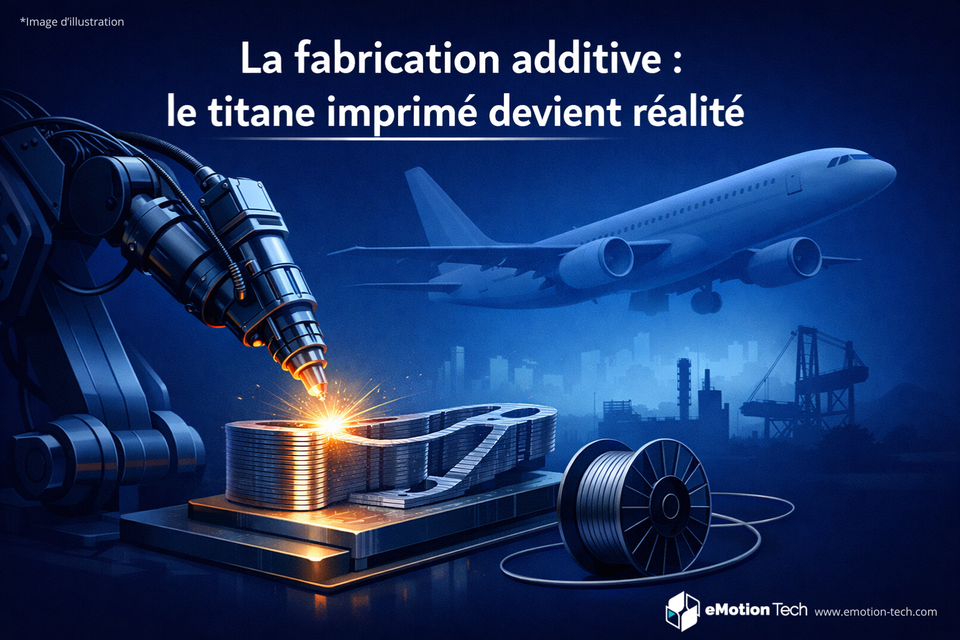
3D-Printed Titanium: A Revolution for Industrial Additive Manufacturing
Additive manufacturing is no longer limited to prototyping or small series. It is now establishing itself as a strategic solution for the production of critical structural parts.
Latest example: Airbus has integrated 3D-printed titanium components into serial production for the Airbus A350, using wire-Directed Energy Deposition (w-DED) technology.
Parts up to 7 meters long can now be manufactured from a simple titanium wire spool, with a significant reduction in material waste. A strong signal sent to all industrial sectors.
Why Is Titanium Strategic in Aerospace?
Titanium is a key material in the aerospace industry for several reasons:
- Excellent mechanical strength
- High strength-to-weight ratio
- Compatibility with modern composite structures
- Corrosion resistance
However, it is also a costly and energy-intensive raw material to produce.
The Limits of Traditional Methods
With conventional processes (forging and machining), manufacturing a titanium part often involves a very high scrap rate:
- Up to 80 to 95% of the initial material can be removed and then recycled
- Significant machining times
- Heavy and costly tooling
- Extended production lead times
Even if the material is recycled, the energy and economic impact remains considerable.
w-DED: A Technology That Changes the Game
Wire-Directed Energy Deposition (w-DED) technology is based on depositing melted metal wire using a concentrated energy source (laser or electric arc).
Near Net Shape Manufacturing
The main advantage: the part is produced in near net shape, meaning very close to its final geometry.
Direct consequences:
- Drastic reduction in material waste
- Reduction in machining operations
- Less specific tooling
- Shorter development cycles
Metal additive manufacturing thus becomes a major lever for industrial optimization.
Beyond Titanium: The Rise of Industrial 3D Printing
What is happening goes far beyond the aerospace sector.
Today, various additive manufacturing technologies are transforming industrial standards:
- Titanium in DED
- Powder bed metal printing
- High-performance polymer FDM
- Hybrid technologies
Additive manufacturing now enables:
Topology optimization
Lightweight structures while maintaining mechanical performance.
Part consolidation (Designed for Additive Manufacturing)
Reduction in the number of components and simplification of assemblies.
Supply chain reduction
More local production, less dependent on multiple suppliers.
Agile production
Rapid adaptation to design changes and market needs.
Improved material-to-performance ratio
Less waste, better industrial efficiency.
A Technology Now Mature
Industrial 3D printing is no longer an experimental alternative.
It now addresses the strategic challenges of sectors such as:
- Aerospace
- Automotive and mobility
- Energy
- Medical
- Defense
- Mechanical industry
The ability to produce critical structural titanium parts at scale confirms the maturity of metal additive manufacturing.
What Impact for Industry Today?
The Airbus example illustrates a fundamental trend:
Additive manufacturing is becoming a strategic tool to:
- Reduce overall costs
- Accelerate innovation
- Improve sustainability
- Gain competitiveness
The race toward industrialization of additive manufacturing is underway — and it concerns all industrial sectors.
Source: Airbus, January 2026.