
 +33 (0)5 82 95 26 62


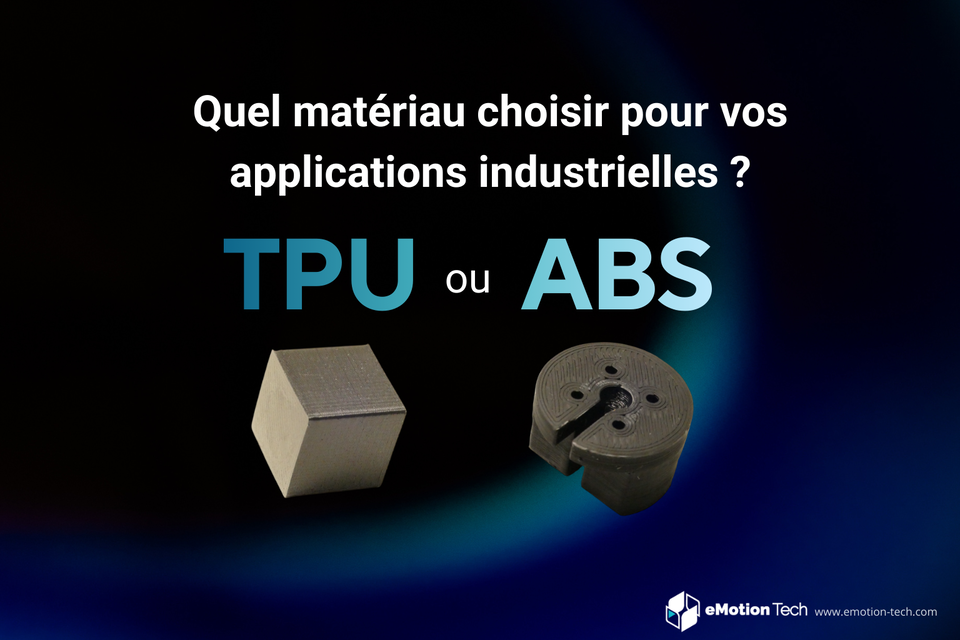
ABS vs TPU: Choosing the Right Material for Industrial 3D Printing
In FFF/FDM additive manufacturing, the performance of a part depends directly on the material used. Two technical polymers dominate many industrial applications: ABS (Acrylonitrile Butadiene Styrene) and TPU (Thermoplastic Polyurethane).
Although they are often opposed, they actually meet very different needs. The real challenge is not to know which is “the best,” but which is the most suitable for your industrial use.
ABS in 3D Printing: Strength, Rigidity, and Thermal Resistance
What is ABS?
ABS is a technical thermoplastic widely used in industry for its mechanical properties and thermal stability. It is commonly found in automotive, household appliances, and technical housings.
Key properties of ABS
Excellent mechanical strength
Good impact resistance
High glass transition temperature (~105°C)
Good post-print machinability
Possibility of chemical smoothing (acetone vapor)
Typical industrial applications
Structural parts
Technical housings and enclosures
Tooling and jigs
Functional prototypes under stress
ABS is particularly suitable when the part must withstand loads, heat, or repeated mechanical stress.
TPU in 3D Printing: Flexibility, Elasticity, and Shock Absorption
What is TPU?
TPU is a flexible polymer combining the properties of rubber and technical plastics. It is designed to absorb deformation and return to its original shape without breaking.
Key properties of TPU
- High elasticity
- Abrasion resistance
- Excellent shock and vibration absorption
- Resistance to oils and greases
- High elongation at break
Typical industrial applications
- Seals and bellows
- Damping parts
- Soles and protective elements
- Anti-vibration components
- Flexible ducts
TPU is ideal when the part must deform without breaking, absorb energy, or provide a damping function.
ABS vs TPU: Technical Comparison for Industry
Rigidity vs flexibility
- ABS → rigid, structural
- TPU → flexible, functional
Thermal resistance
- ABS → better heat resistance
- TPU → more thermally limited depending on the grade
Impact resistance
- ABS → good resistance, but rigid material
- TPU → absorbs energy through deformation
Printing complexity
In an industrial environment, printing these materials requires:
- Precise thermal control
- Stable heated bed
- Enclosed chamber for ABS (to prevent warping)
- Adapted extrusion for TPU (handling flexible materials)
Print reliability depends as much on the machine as on the material.
How to Choose Between ABS and TPU for Your Industrial Application?
The real question to ask is:
How should the part behave under real conditions?
Choose ABS if:
- The part must be rigid
- It is subject to significant mechanical stress
- It is exposed to heat
- It serves as a structural element
Choose TPU if:
- The part must be flexible
- It must absorb vibrations or impacts
- It undergoes repeated deformation
- It fulfills a sealing or damping function
ABS and TPU: Complementary Materials, Not Competitors
In an industrial environment, ABS and TPU do not compete. They address different mechanical needs.
A high-performance machine fleet makes it possible to use both materials depending on the project:
- Rigid prototypes in ABS
- Flexible components in TPU
- Multi-material assemblies
The key lies in understanding usage constraints and mastering printing parameters.
Conclusion: The Right Material Is the One That Matches Your Function
In industrial 3D printing, the choice between ABS and TPU should not be guided by the popularity of the material, but by the expected performance of the final part.
Structural rigidity or functional flexibility?
Thermal resistance or shock absorption?
The ideal material is the one that precisely meets your specifications.
Are you hesitating between ABS and TPU for your application?
Our teams support you in choosing the right material and optimizing your printing parameters to ensure reliable, durable parts tailored to your industrial constraints.