 +33 (0)5 82 95 26 62


Integrating 3D printing into an industrial workflow: methodology and best practices
Industrial 3D printing is now established as a strategic lever for companies looking to gain agility, reduce costs, and accelerate their production cycles.
However, to fully benefit from it, its integration must be approached in a structured way. Here are the essential steps to successfully integrate additive manufacturing into your industrial workflow.
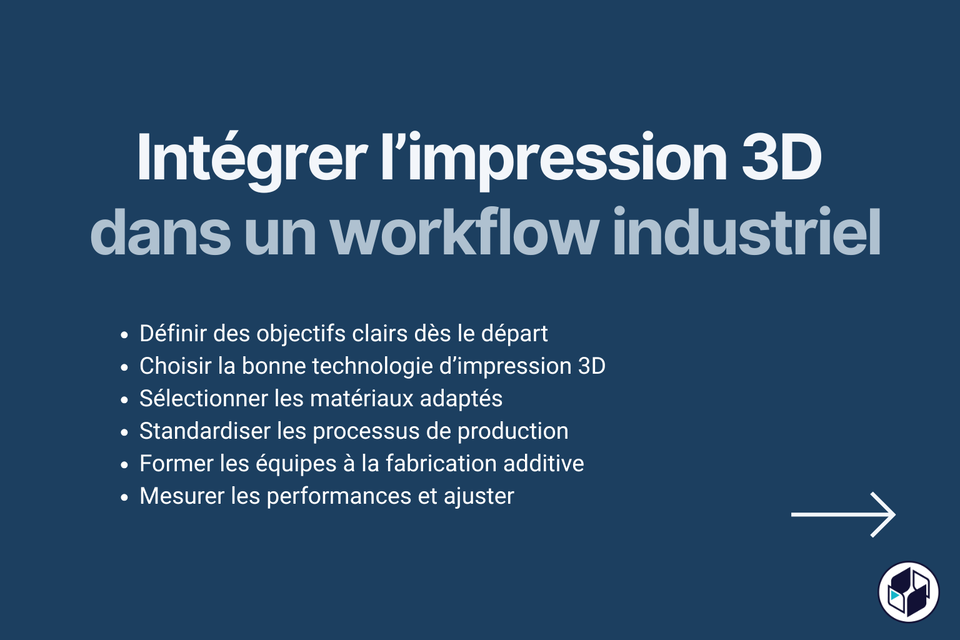
Define clear objectives from the start
First and foremost, it is essential to clearly identify your needs.
Identify use cases
3D printing can address several objectives:
- Rapid prototyping
- Manufacturing of functional parts
- Production of small and medium series
- Reduction of costs and lead times
Align the technology with your industrial challenges
Clear objectives make it possible to choose the most suitable equipment and technologies for your activity.
Choose the right 3D printing technology
Not all additive manufacturing technologies meet the same needs.
Main technologies used in industry
- FFF / FDM: versatile, robust, and cost-effective solution, ideal for prototyping and certain functional parts
- SLA: high precision and excellent surface finish, suitable for aesthetic prototypes
- SLS: perfect for technical parts and serial production
Adapt the technology to your constraints
The choice depends on several criteria:
- Required level of precision
- Expected mechanical strength
- Production volume
- Budget
Select the appropriate materials
Material plays a central role in the performance of produced parts.
Material selection criteria
- Mechanical strength
- Durability
- Surface quality
- Compatibility with the operating environment
Examples of common materials
- PLA
- ABS
- PETG
- TPU
- Nylon
- Composite materials
A good choice of material ensures the reliability and longevity of parts.
Standardize production processes
For successful integration, it is essential to structure workflows.
Establish clear procedures
Define standards for:
- Printing parameters
- Filament storage and preparation
- Quality control
- Part validation
Ensure equipment maintenance
Preventive maintenance helps to:
- Avoid production downtime
- Ensure consistent quality
- Optimize machine lifespan
Train teams in additive manufacturing
People are a key success factor.
Build skills
Teams must:
- Understand the technologies and their limitations
- Know how to optimize printing parameters
- Choose the right materials
Encourage internal adoption
Proper training ensures efficient, safe, and sustainable use of equipment.
Measure performance and adjust
Once 3D printing is integrated, it is essential to measure its benefits.
Key performance indicators to monitor
- Reduction in production lead times
- Decrease in prototyping costs
- Improvement in part quality
- Return on investment (ROI)
Continuously optimize
Analyzing results allows processes to be adjusted and the industrial workflow to be continuously improved.
Conclusion: a strategic lever for industry
Industrial 3D printing is not just a machine. It represents a true lever for innovation, performance, and flexibility.
When properly integrated into a structured workflow, additive manufacturing enables companies to gain competitiveness and accelerate their industrial transformation.