
 +33 (0)5 82 95 26 62


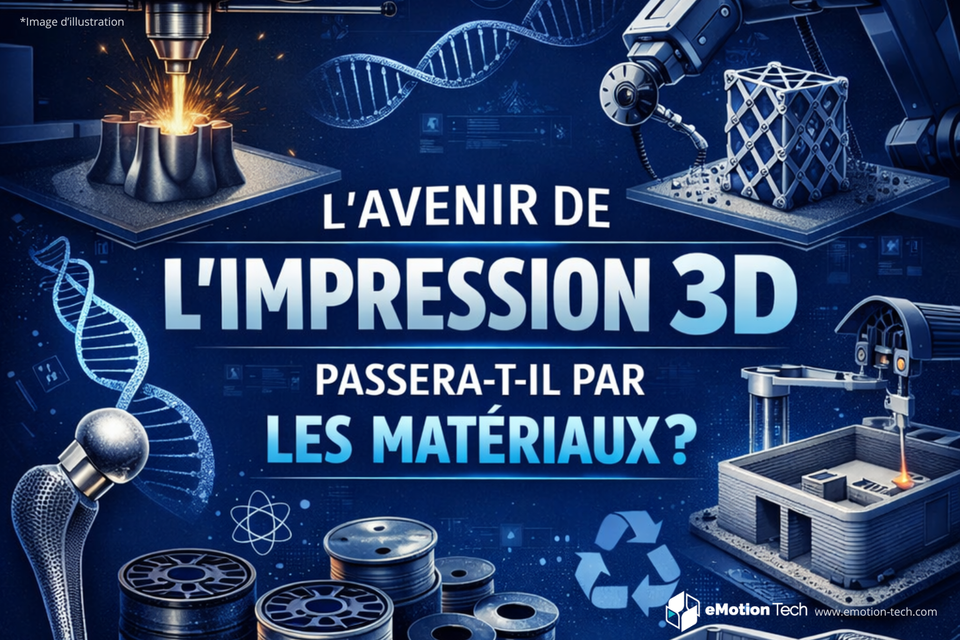
Will the future of industrial 3D printing depend on materials?
Additive manufacturing (AM), more commonly known as 3D printing, is profoundly transforming industry. From aerospace to medical, including energy, automotive, and construction, it is redefining design and production methods.
An article published on The Conversation by Benoît Vieille and Thomas Breteau, then relayed by Science & Vie, highlights a key question:
what if the real breakthrough no longer came solely from machines, but from the materials themselves?
Industrial 3D printing: when parameters influence the material
In additive manufacturing, the final performance of a part does not depend solely on design.
It is directly linked to printing parameters:
- Extrusion temperature
- Printing speed
- Layer orientation
- Infill rate
- Cooling conditions
Microstructure and mechanical properties
Unlike traditional processes, the internal microstructure of a printed part is strongly influenced by the process itself.
Mechanical strength, thermal resistance, fatigue behavior: everything is linked to how the material is deposited.
This means that in industrial 3D printing, the machine and the material cannot be separated.
Geometries impossible with traditional manufacturing
Additive manufacturing makes it possible to produce shapes that are impossible to achieve through machining or conventional molding:
- Monolithic rocket injectors
- Custom anatomical prostheses
- Injection molds with integrated cooling channels
- Topology-optimized lightweight structures
Optimized topology and biomimicry
Lattice architectures and structures inspired by nature make it possible to create parts that are:
- Lighter
- Stronger
- Precisely adapted to mechanical constraints
These advances are inseparable from the ability to develop materials compatible with these complex geometries.
The real challenge: developing high-performance materials
While industrial 3D printing is progressing, materials remain a major strategic challenge.
Still high costs
Technical powders and filaments can cost up to 10 times more than conventional materials.
They must meet strict criteria:
- Mechanical strength
- Durability
- Thermal stability
- Recyclability
- Non-toxicity
Finishing and post-processing: an essential link
After printing, finishing processes play a key role:
- Depowdering
- Machining
- Heat treatments
- Surface improvement
These steps make it possible to:
- Reduce porosity
- Improve mechanical reliability
- Ensure part longevity
Hybridization and multi-material printing: towards intelligent parts
Multi-head printing and hybridization open the way to new composites:
- Targeted mechanical properties
- Integrated electrical conductivity
- Specific thermal performance
We move from a simple structural part to an integrated functional part, capable of meeting complex requirements.
Economic and environmental impact of additive manufacturing
Real environmental gains
Waste reduction (no chips as in machining)
Lighter structures → reduced energy consumption
Elimination of costly molds for small series
Limits to manage
- High initial investment
- Cost of technical materials
- Sometimes limited availability
The transition to reliable industrial production therefore depends as much on the machine as on the entire material chain.
Mastering materials: key to moving from prototype to production
At eMotion Tech, we observe daily that the success of an industrial project does not rely solely on the performance of the 3D printer.
Selecting the right filament or technical material, optimizing parameters, and understanding application constraints are decisive to:
- Move from prototype to series
- Ensure repeatability
- Guarantee mechanical reliability
The future of industrial 3D printing will not depend solely on build volumes or increased speeds.
It will above all depend on the ability of manufacturers to develop, qualify, and master materials suited to each application.
Conclusion: is the revolution material-based?
Additive manufacturing has already transformed production methods.
But the next strategic step may well be advanced, sustainable, and intelligent materials.
The question remains open:
does the real revolution in 3D printing lie in the machine… or in the material?