
 +33 (0)5 82 95 26 62


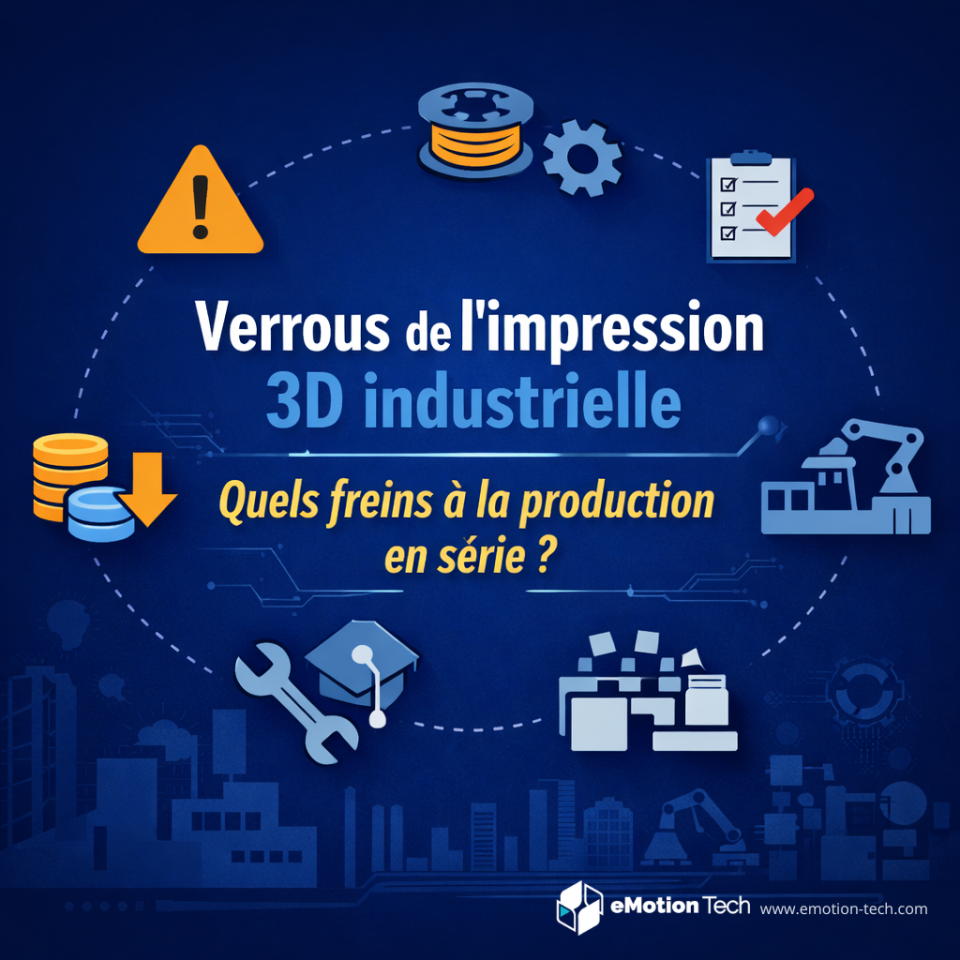
Barriers to Industrial 3D Printing: Current Situation and Perspectives
Industrial 3D printing, or additive manufacturing, has established itself as an essential tool for rapid prototyping, tooling, and small series production. The benefits are well known: reduced lead times, design freedom, local production, increased flexibility.
Yet, when it comes to series production or integration into demanding industrial environments, its adoption remains gradual.
Why?
The obstacles are no longer purely technological. They are now organizational, regulatory, and cultural.
1. Process Reliability and Repeatability
A central challenge for production
In an industrial environment, the question is not whether a single part can be produced successfully, but whether dozens or hundreds can be produced with the same quality.
Print repeatability depends on several factors:
-
Mechanical stability of the machines
-
Thermal control
-
Precise calibration
-
Material parameter management
-
Preventive maintenance
Without fine process control, variability can become a major barrier to industrialization.
2. Mastery of Technical Materials
Performance to be secured
The use of technical materials (ABS, reinforced PETG, nylon, composites, filled polymers…) requires:
-
A perfect understanding of their thermal constraints
-
Control of shrinkage and deformation
-
Management of interlayer adhesion
-
Controlled environmental conditions
The mechanical performance of a printed part depends as much on the material as on the printing process.
3. Part Qualification and Compliance with Industrial Standards
A necessary step for certain sectors
In sectors such as aerospace, medical, or energy, part qualification is essential.
This involves:
-
Material traceability
-
Dimensional validation
-
Measured repeatability
-
Process documentation
-
Compliance with sectoral standards
3D printing must fit within a quality logic comparable to traditional processes.
4. Integration into Existing Production Flows
An organizational change
One of the major barriers is not technical but organizational.
Integrating industrial 3D printing into a production line involves:
-
Adapting workflows
-
Training teams
-
Defining relevant use cases
-
Considering internal logistics
Additive manufacturing does not systematically replace traditional processes; it complements them intelligently.
5. Internal Skills and Cultural Adoption
Training to industrialize
Without strong internal skills, adoption remains superficial.
Teams must master:
-
Design for additive manufacturing (DfAM)
-
Machine setup
-
Maintenance
-
Cost optimization
Skills development is a key success factor.
6. Perception of Real Costs
A sometimes biased view
Comparing the cost of a printed part solely to its material cost is reductive.
One must include:
-
Lead time reduction
-
Elimination of tooling
-
Stock reduction
-
On-demand production
-
Customization
The analysis must be global and strategic.
Industrial 3D Printing: Already a Mature Technology?
At eMotion Tech, we consider 3D printing already a full-fledged production technology, provided it is approached with an industrial vision:
-
Machines designed for repeatability
-
Robust and stable structures
-
Mastery of technical materials
-
Reliable processes
-
Appropriate support and training
The challenge is no longer to prove the relevance of additive manufacturing, but to structure its use to fully exploit it.
Towards Wider Adoption in Production?
The current market evolution shows growing maturity among industrial players.
The question is no longer, “Does 3D printing work?”
But rather:
How can it be sustainably and intelligently integrated into an industrial strategy?