
 +33 (0)5 82 95 26 62


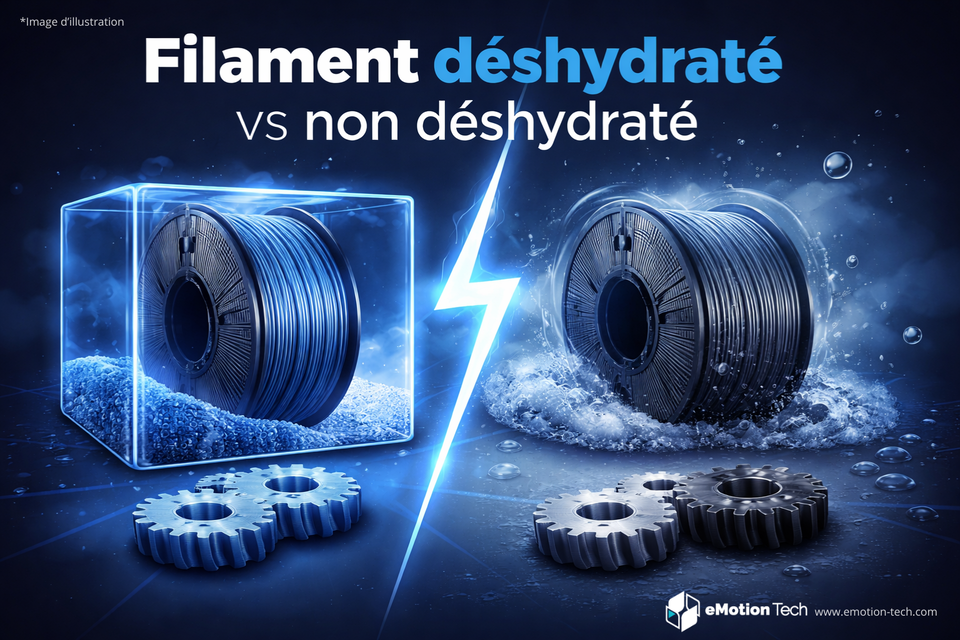
Dehydrated Filament vs Non-Dehydrated Filament: A Key Factor in Industrial 3D Printing
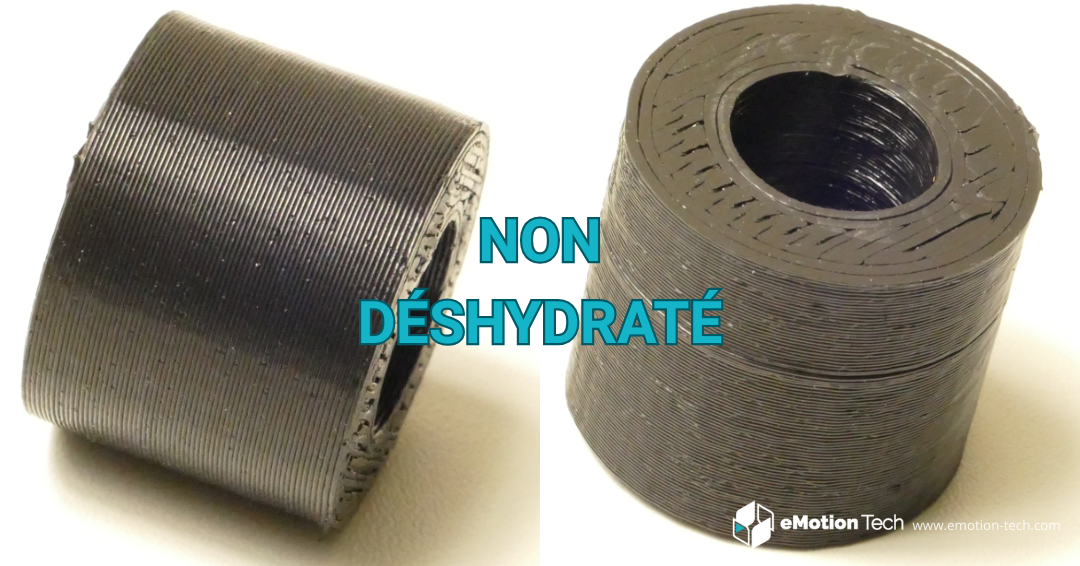
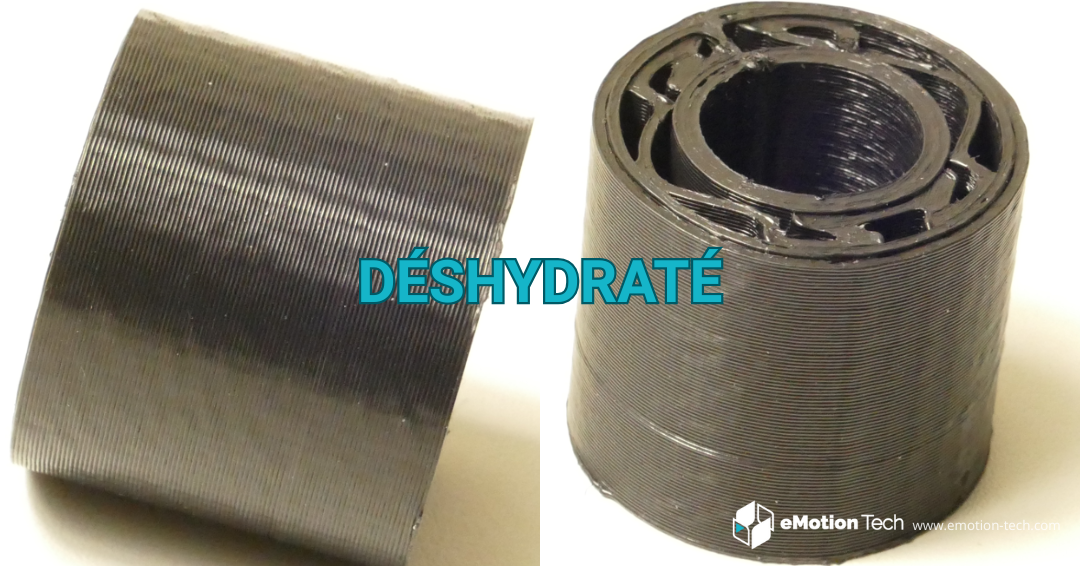
Before getting into the theory, we conducted a simple test: printing the same part in TPU, using the same machine, the same parameters, and the same environment.
Only one variable changed: the filament’s moisture content.
Result: a significant difference in print quality, extrusion consistency, and the final appearance of the part.
In industrial FDM/FFF 3D printing, performance does not depend solely on the machine or the slicer. The state of the material is an essential link in the process.
Why Is Moisture a Problem in FDM 3D Printing?
Most technical filaments (ABS, PA, PC, TPU, composite materials…) are hygroscopic.
They naturally absorb moisture from the ambient air.
When passing through the heated nozzle, this moisture turns into vapor, creating:
-
Micro-bubbles
-
Pressure variations
-
Extrusion instability
-
Surface defects
These phenomena compromise part quality, especially in an industrial production context where repeatability is essential.
Comparison: Non-Dehydrated Filament vs Dehydrated Filament
Non-Dehydrated Filament
-
Irregular extrusion (“popping” noise)
-
Degraded visual appearance
-
Poor inter-layer adhesion
-
Unstable mechanical properties
-
Higher scrap rate
Poorly compatible with a reliable and controlled production logic
Dehydrated Filament
-
Consistent material flow
-
Smoother and more uniform surfaces
-
Better inter-layer fusion
-
Mechanical properties close to theoretical values
-
Increased repeatability from one print to another
A prerequisite for demanding technical and industrial prints
Filament Dehydration: Best Practices
To ensure consistent quality in FDM additive manufacturing, it is recommended to:
Store spools properly
-
Airtight containers
-
Desiccant packs
-
Dedicated dry cabinets
Dehydrate before printing
-
Suitable oven
-
Specific filament dryer
-
Dedicated drying station
Keep filament dry during printing
-
Dry box
-
Closed system
-
Ambient humidity control
Adjust temperature and duration
Each material has its own recommendations (TPU, PA, PC, ABS…).
Respecting these parameters prevents thermal degradation or insufficient drying.
A Direct Lever on Industrial Performance
Filament dehydration is not a mere technical detail.
It is a determining factor for:
-
Visual quality
-
Mechanical performance
-
Repeatability
-
Scrap reduction
-
Production reliability
In an industrial logic, every process variable counts.
The material is no exception.
Towards Truly Industrial 3D Printing
At eMotion Tech, we integrate material control into our global approach: machine + parameters + environment + process.
The goal: support our users towards reliable, reproducible FDM 3D printing adapted to industrial requirements.
Because in additive manufacturing, performance does not depend solely on the machine… but on complete mastery of the entire printing ecosystem.